
Fix collaboration to fix learning
Organizational learning doesn't break because people aren't learning — it breaks because insights, ideas, and lessons can't travel without real collaboration.

Organizational learning doesn’t live in slides or systems — it lives in how people work together.
We talk a lot about making organizations more adaptive, more resilient, more innovative. But we rarely talk about the mechanics of how organizations learn.
Not individuals. Not teams. The organization as a whole.
And here’s the problem: we often assume that if individuals are learning, then the organization is too. That’s rarely true.
Real organizational learning isn’t about content or courses. It’s about how insights move — how something noticed in one part of the business becomes a conversation, an experiment, and eventually a new way of working across the system.
It’s a loop. And that loop breaks when collaboration breaks.
What happens when collaboration is missing
Without collaboration:
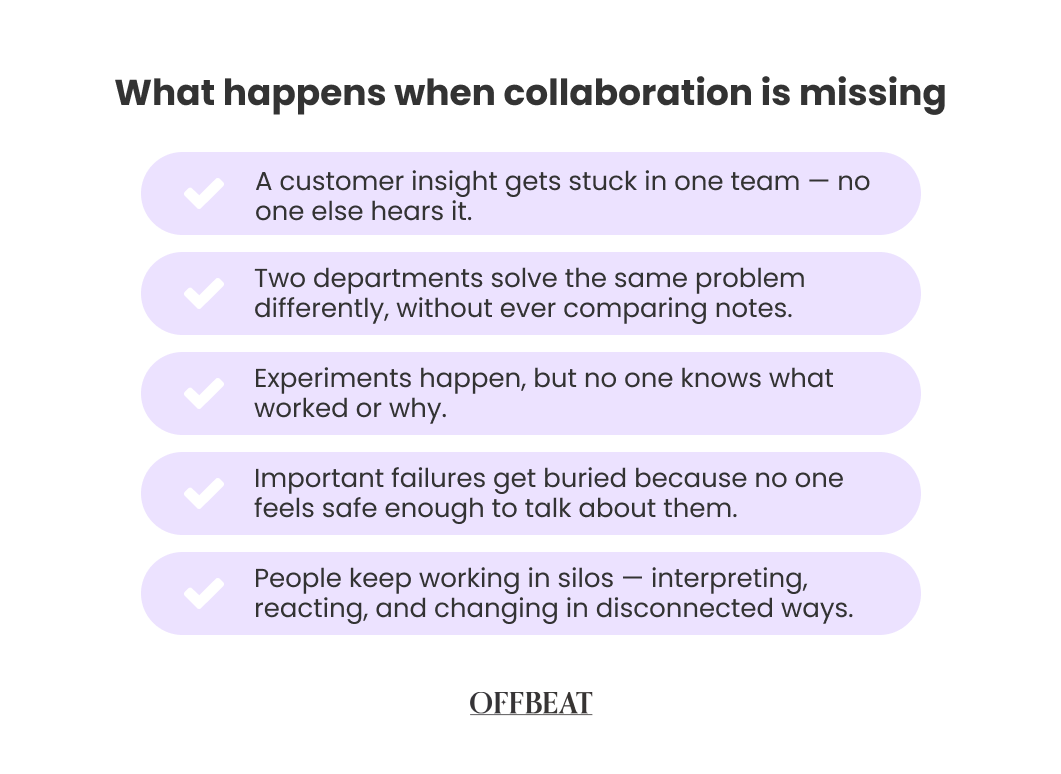
A customer insight gets stuck in one team — no one else hears it.
Two departments solve the same problem differently, without ever comparing notes.
Experiments happen, but no one knows what worked or why.
Important failures get buried because no one feels safe enough to talk about them.
People keep working in silos — interpreting, reacting, and changing in disconnected ways.
And that means the organization doesn’t learn. It reacts. At best, it patches.
What collaboration makes possible
Organizational learning follows a cycle. We notice things. We make sense of them. We try new things. We share what works. Then we do it all over again.
Here’s how collaboration enables that cycle:
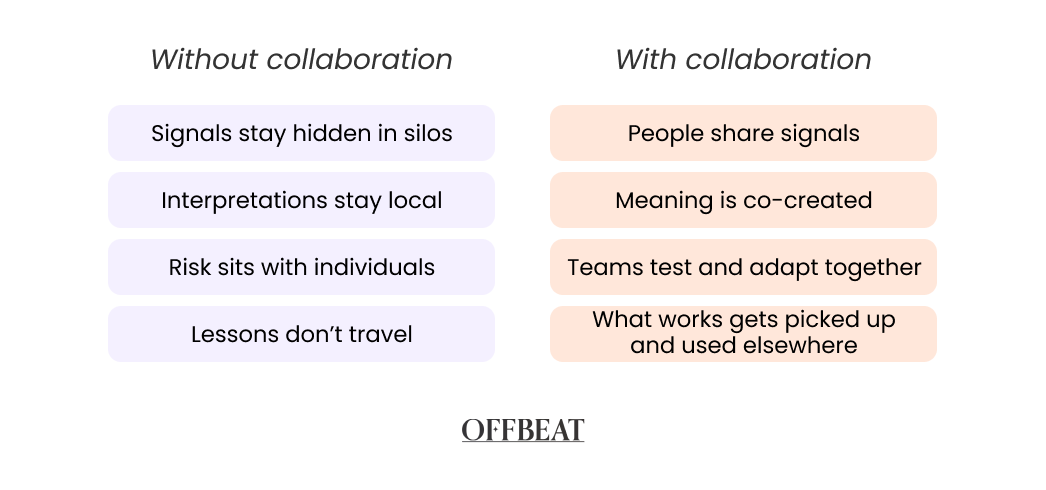
When collaboration is strong, insights flow. Ideas spread. Mistakes teach. And learning becomes systemic.
So how do we fix collaboration?
This isn’t just about being nicer to each other. It’s about designing for connected sense-making.
Some ways to start:
Make space for shared reflection. Create regular rituals — beyond retros — where people surface patterns, hunches, or tensions across the org.
Reward openness, not just outcomes. Celebrate people who share experiments, even if they didn’t “succeed.”
Build bridges across functions. Bring teams together to solve real problems, not just attend joint updates.
Support lateral learning. Encourage people to shadow others, swap insights, and co-create solutions outside their usual circle.
Treat knowledge like infrastructure. Make it easier to find what’s been tried, what worked, and what didn’t.
If your organization isn’t learning fast enough, start by asking: Where is collaboration getting in the way?
Not the tools — the conversations. The habits. The defaults.
Because learning doesn’t scale on its own. It needs people to carry it — to shape it, test it, share it, and make it matter across the system.
Before you update your learning strategy, fix the system it’s meant to live in. Fix collaboration, and you might just fix learning.
If you’re finding this newsletter valuable, share it with a friend and consider subscribing if you haven’t already.